Sierra Energy: Building the Future of Waste Conversion
Founded in 2004 in Davis, California, Sierra Energy was created around a simple but ambitious idea: that society's waste could become one of its most valuable resources. Rather than viewing municipal solid waste, biomass, and other discarded materials as liabilities destined for landfills, the company's founders envisioned a technology capable of transforming them into clean energy, renewable fuels, and reusable materials. That vision became FastOx® gasification, a proprietary process built upon proven blast furnace principles and adapted for the modern challenges of waste management, energy security, and decarbonization.
The origins of FastOx stretch back even further. The core concept grew from work by former Kaiser Steel engineers Bruce Claflin and John Jasbinsek, who recognized that blast furnace technology could do far more than produce steel—it could safely and efficiently convert waste into valuable synthesis gas. Sierra Energy acquired the rights to the technology and began the long process of transforming an industrial concept into a commercially viable platform. Under the leadership of founder Mike Hart, the company assembled a multidisciplinary team of engineers, scientists, and industry experts committed to solving one of the world's most persistent environmental problems.
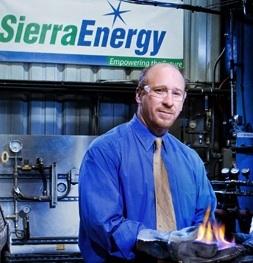
The early years were devoted almost entirely to research and development. Beginning in 2009, Sierra Energy partnered with the U.S. Department of Defense at the Renewable Energy Testing Center (RETC) in Sacramento, where successive generations of prototype gasifiers validated the underlying science and engineering. Through multiple design iterations, the company demonstrated that FastOx could process a wide variety of feedstocks—including municipal solid waste, biomass, tires, and other difficult materials—while producing high-quality synthesis gas and an environmentally stable vitrified stone rather than hazardous ash requiring disposal. These demonstrations provided the technical foundation for scaling the technology to commercial size.
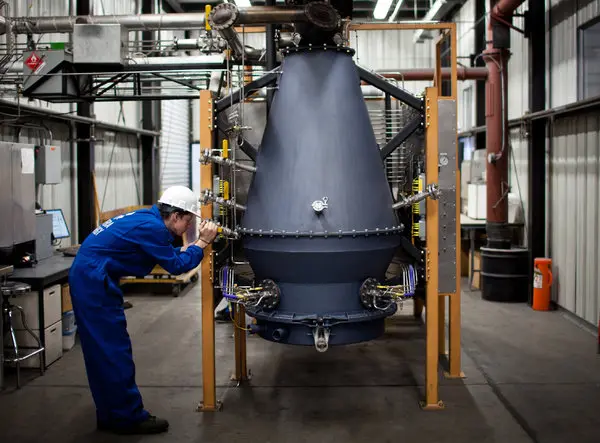
That progress attracted significant public-sector support. In 2012 and 2013, Sierra Energy received funding from both the U.S. Department of Defense and the California Energy Commission to construct its first commercial-scale demonstration facility at U.S. Army Garrison Fort Hunter Liggett in Monterey County. The project aligned closely with the military's goals of improving energy resilience while reducing waste sent to landfills, and it became one of the Department of Defense's flagship demonstrations of advanced waste-to-energy technology.
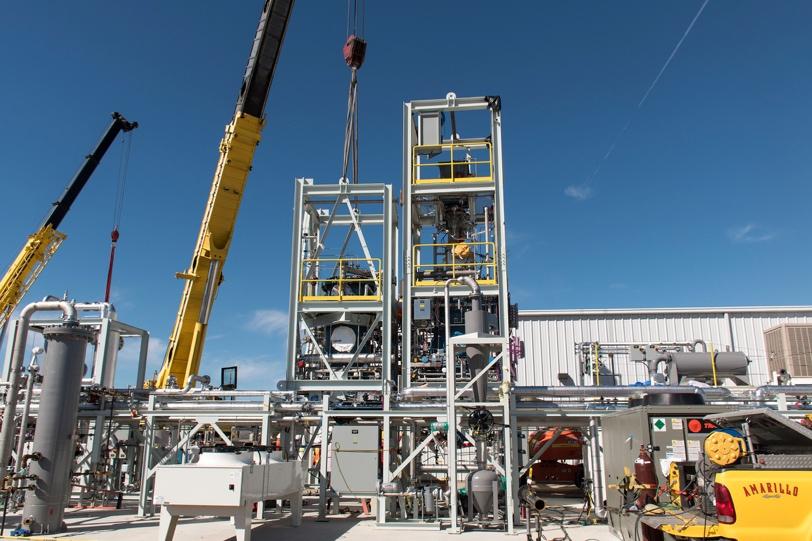
Over the following decade, Sierra Energy steadily advanced FastOx from concept to proven demonstration. The Fort Hunter Liggett facility accumulated more than 1,250 documented operating hours while successfully converting municipal solid waste and waste wood into clean synthesis gas with approximately 80 percent cold-gas efficiency. The system also demonstrated one of FastOx® technologies’ defining advantages: converting inorganic materials into an inert, vitrified stone suitable for beneficial reuse rather than creating new waste streams requiring disposal. These results established confidence that the technology could serve as a flexible platform for producing electricity, hydrogen, renewable methanol, sustainable aviation fuel, and other valuable products from waste.
This appears to be a photograph of an operational facility rather than a chart, diagram, or data figure—no numerical data values, axes, percentages, or graphical labels are visible beyond the company branding.]
As technical milestones accumulated, so did industry recognition. Sierra Energy secured an expanding portfolio of patents and intellectual property, completed front-end engineering studies for larger commercial facilities, and attracted investment from organizations committed to accelerating climate and energy innovation, including Breakthrough Energy Ventures. Independent benchmarking has since identified FastOx as one of the most capital-efficient municipal solid waste gasification technologies evaluated, reinforcing the company's belief that commercial deployment can compete economically while delivering significant environmental benefits.
Today, Sierra Energy remains focused on commercialization. The company's next-generation (Gen 2) gasifier incorporates lessons learned from years of operation, simplifying the system while improving efficiency, lowering expected capital costs, and increasing operational flexibility. The Gen 2 unit has been fabricated and delivered to Fort Hunter Liggett, where installation and long-term operation are expected to establish a new commercial reference plant for customers and development partners.
At the same time, Sierra Energy has broadened its vision well beyond traditional waste management. Growing demand for reliable power from artificial intelligence and data centers has created new opportunities for around-the-clock renewable baseload generation. Current project development efforts span the United States and international markets, reflecting increasing interest from municipalities, industrial companies, developers, and infrastructure investors.
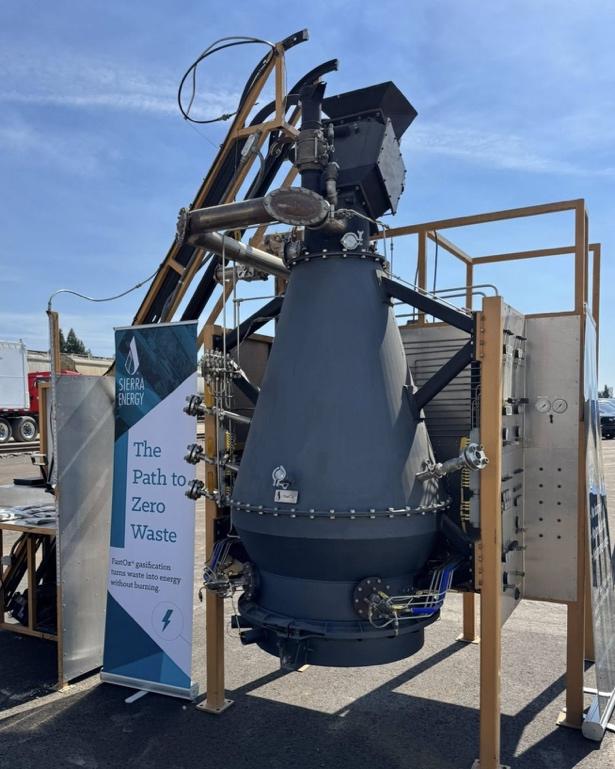
Looking ahead, Sierra Energy is pursuing a commercialization strategy that combines direct project development with territorial distribution through the TechPipe™ platform. By enabling approved regional distributors to identify and advance opportunities under Sierra Energy's technical standards, the company aims to accelerate deployment while maintaining the quality and consistency of the FastOx platform.
More than two decades after its founding, Sierra Energy remains guided by the same principle that inspired its creation: that waste should not be buried but transformed into value. While the company continues its transition from successful demonstration to broad commercial deployment, its mission has remained remarkably consistent—to provide practical technologies that reduce landfill dependence, strengthen energy resilience, and help create a more circular, lower-carbon economy.
Primary document · also published in the TechPipe™ knowledge base ↗.